01 / Children
Eating textures that feel hard.
Gagging on lumpy food, refusing meat or bread, packing food in the cheeks, slow eaters who never seem hungry. Tongue mobility plays a quiet role in how children learn to chew and swallow.

You've heard the words "tongue tie" more than once — from a dentist, a speech pathologist, or after years of wondering why your tongue can't quite get where it needs to go. Here's what the assessment looks like, and the visit that follows. No pressure.
You probably don't need someone else telling you something might be a tongue tie. What you need is someone to walk you through what the assessment involves — and what the visit actually feels like, whether you're booking for your child, your teen, or yourself.
So let's start there. Calmly. Clinically. And without pressure to book anything until the assessment makes the answer clear.
— The Magical Smiles laser team
A restrictive frenulum can show up at almost any age that walks into a dental chair. Sometimes it shows up as a school-aged child whose speech sounds aren't coming. Sometimes as a teen with a gap between the front teeth. Sometimes as an adult whose jaw has clicked since university. Here's what we see most often.
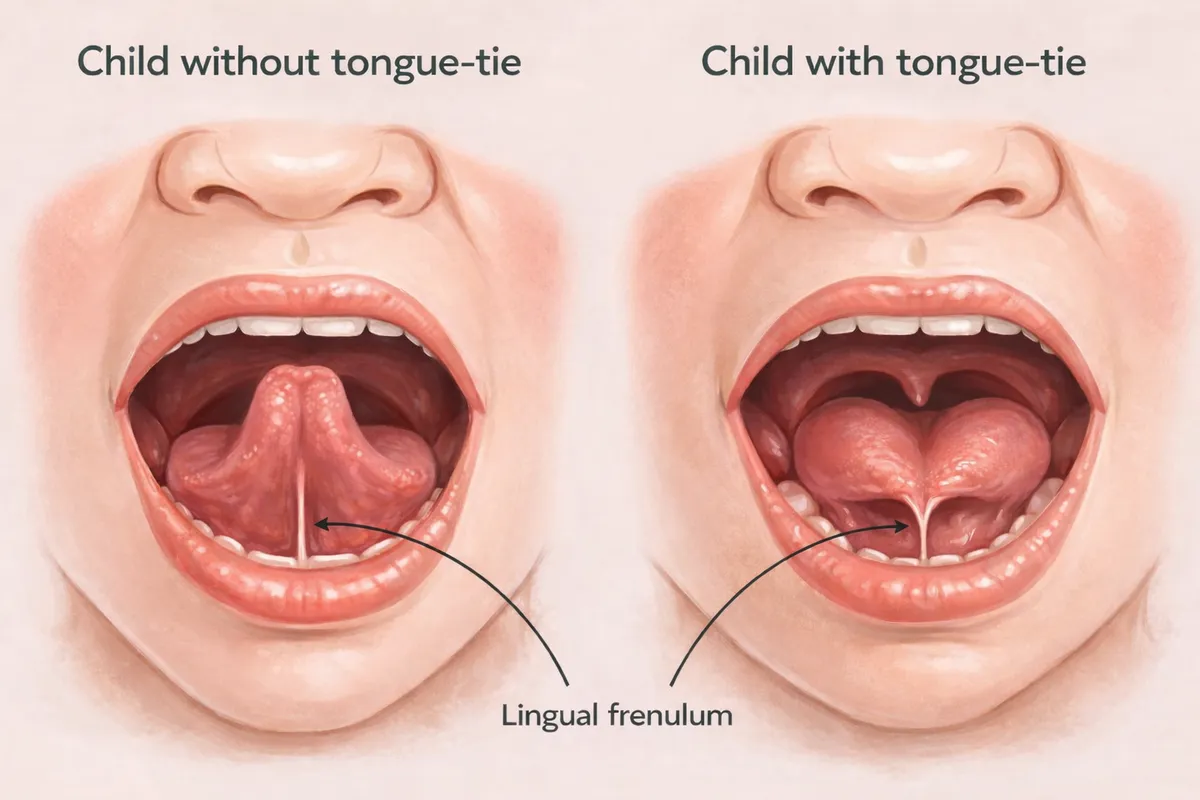
The lingual frenulum is the thin band of tissue under the tongue. In most mouths it's loose enough that the tongue lifts and stretches freely. When it's shorter, thicker, or attached further forward, tongue movement is restricted — that's what's meant by a "tongue tie." A similar band under the upper lip can restrict lip movement instead, which is what's meant by a lip tie. The same platform is also used for laser gum depigmentation.
Diagram is illustrative and general — anatomy and severity vary between individuals. An in-chair functional assessment is what actually determines whether release is appropriate for you or your child.
Gagging on lumpy food, refusing meat or bread, packing food in the cheeks, slow eaters who never seem hungry. Tongue mobility plays a quiet role in how children learn to chew and swallow.
Persistent difficulty with 'r', 'l', 's', 'th' — sounds the tongue tip needs height and flexibility to make. Speech pathology stays the lead; release is considered when restriction is clearly part of the picture.
A persistent gap between the upper front teeth (diastema), held in place by a thick labial frenum. Often a key consideration in orthodontic planning, and a quiet daily frustration in every photo.
Restricted tongue elevation, jaw tension, mouth breathing at night, or the quiet sense your tongue has always sat a little low. It is rarely too late to assess.
A tight lower lingual frenum pulling on the gum margin can contribute to recession behind the bottom front teeth. Release sometimes accompanies periodontal care to take the strain off.
An upper labial frenum that contributes to a diastema, recurring food trap, or recession at the front. Often something patients have noticed for decades and never realised was addressable.
A laser frenectomy uses precisely tuned light energy — not blades — to release the band of tissue restricting the tongue or lip. The Er:YAG wavelength is strongly absorbed by water in soft tissue, so it works fast, in tiny increments, and seals as it goes.
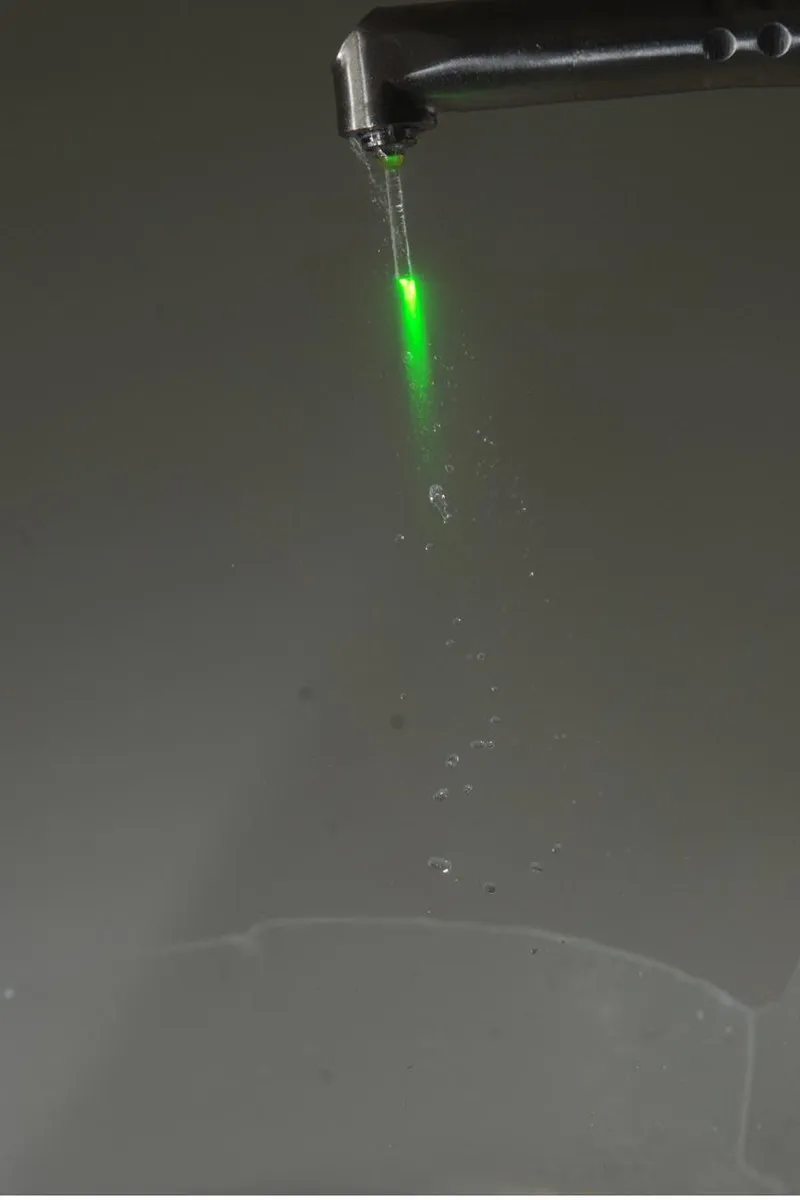
The Er:YAG laser is absorbed by water at almost the exact rate the body would prefer — vaporising the restrictive tissue in tiny, controlled passes while sealing small blood vessels and nerve endings as it works. The result is a release that is usually over in under a minute, typically does not require stitches, and produces little bleeding to manage.
For our patients — older children, teens and adults — it means the appointment feels closer to a long filling than to surgery. You walk in, you sit comfortably, the area is numbed gradually, the laser does its work in seconds, and you walk out with aftercare instructions and a follow-up date.
Magical Smiles uses the Fotona LightWalker — a dual-wavelength Er:YAG and Nd:YAG dental laser system. For tongue and lip tie release, the Er:YAG wavelength is the workhorse: tightly absorbed by soft tissue, gentle on surrounding structures, and well-suited to delicate intraoral anatomy.
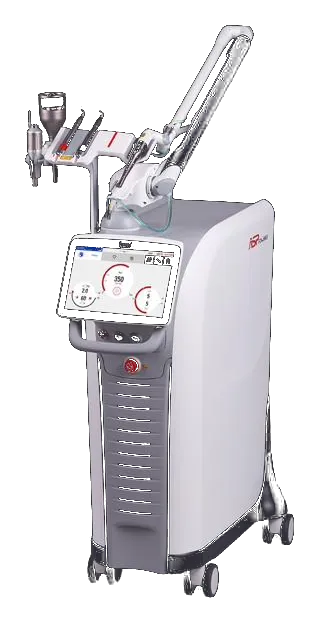
The LightWalker isn't the cheapest laser available. We chose it because it does what soft-tissue work like this asks for — precise depth control, predictable behaviour on small structures, gentle on the underlying muscle, and rapid in the hands of an experienced operator.
The release itself is brief. The reason we spend more time around it is so the assessment is right, the consent is informed, and the aftercare is something you can genuinely do at home in the weeks that follow.
A full history — what brought you in, speech and eating concerns if relevant, dental and gum observations. Calm room, no rush. Bring whoever you want.
Visit 1 · 30 minTongue elevation, lateralisation, speech sample, dental and periodontal check. Coordination with your speech pathologist, orthodontist or GP where applicable.
Visit 1 · 15 minWe talk you through what we found, whether release is genuinely indicated, what to expect, and the alternatives — including doing nothing. Written quote and timing.
Visit 1 · 15 minThe Wand (computer-controlled local anaesthetic) numbs the area gradually at a barely perceptible rate. Protective eyewear for everyone in the room.
Visit 2 · 10 min prepYou're comfortable in the chair, the area is fully numb. The laser portion typically takes 60–90 seconds. No scalpel, no scissors, no sutures in most cases.
Visit 2 · 1–3 minA gentle rinse and a movement check — tongue elevation, lip flange, swallow. The first movements feel different but quickly become normal as the numbness wears off.
Visit 2 · 15–20 minWe demonstrate the wound stretches you will do at home for 2–4 weeks. Written instructions, a short video link, and a number to call if anything worries you.
Visit 2 · 10 minA follow-up visit at 1–2 weeks to check healing and movement, troubleshoot the stretches, and confirm we are on the right track.
Visit 3 · 20 minBoth scissor and laser release are clinically valid techniques performed widely in Australia. Here is how the laser approach typically differs in practice — your clinician will explain which is right for your situation at assessment.
Tongue tie work sits at the intersection of dentistry, speech pathology, orthodontics and periodontics. We try to make our part of the puzzle the quiet, predictable bit you don't have to worry about.
Over ten years of clinical laser dentistry — soft-tissue procedures are not a new addition for us. Frenectomy protocols are well-rehearsed and the team knows what calm looks like.
Dual-wavelength Er:YAG and Nd:YAG — the system used by leading laser dental practices worldwide. The Er:YAG handles the soft-tissue precision this procedure needs.
We work alongside your speech pathologist, orthodontist, GP, paediatrician or periodontist — sharing notes (with your consent) so you are not the courier of your own care.
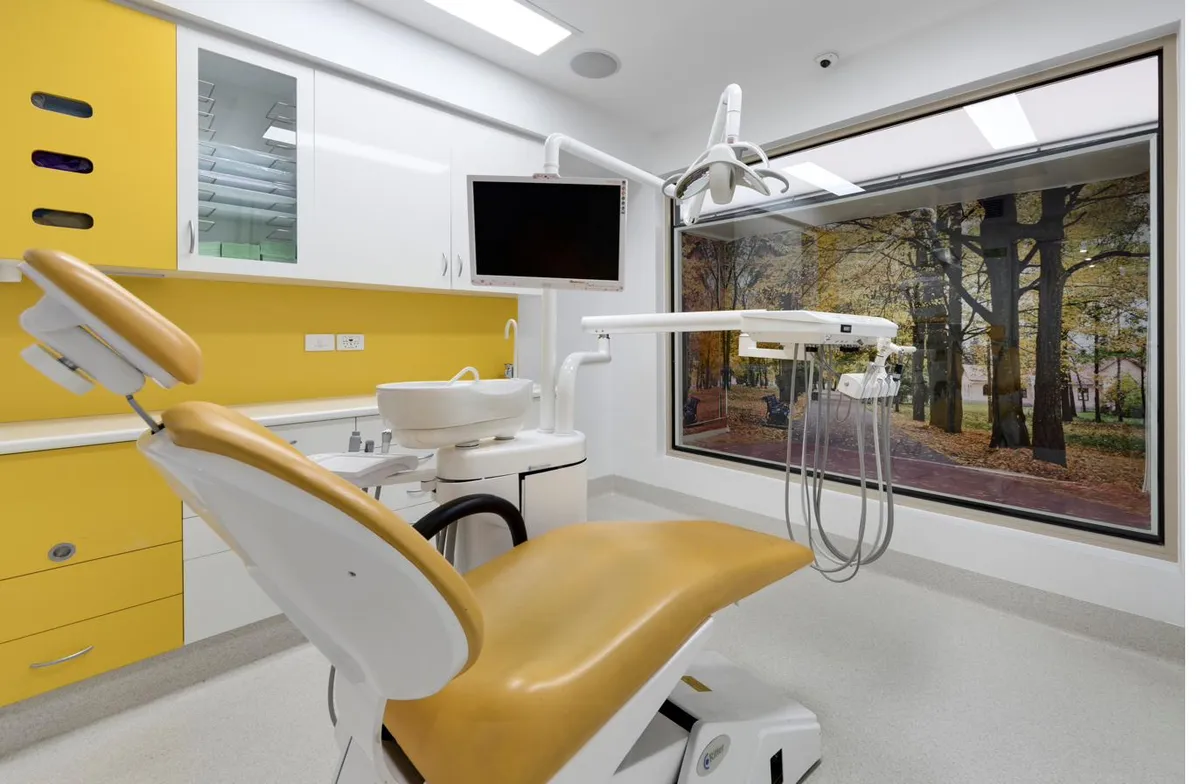
Dedicated paediatric-friendly rooms, dimmable lighting, a kids' lounge for siblings, and longer appointment times so nothing feels rushed.
For children and adults who need local anaesthesia, we use The Wand — computer-controlled flow that delivers numbing at a barely perceptible rate. Often the part patients comment on after.
Not every tie needs releasing, and we will say so when that is what we find. The consultation answers the question — it does not commit you to anything.
Answered plainly, by the team you would see in the chair. Ask anything else when you call — we would rather you ring with twenty questions than book unsure.
Caroline Springs, Bacchus Marsh and Point Cook — each with its own team, parking, and family-friendly waiting area. Phone the one most convenient and we will direct your enquiry to the right pathway.
Burnside · Taylors Hill · Hillside · Sydenham
Maddingley · Darley · Hopetoun Park · Long Forest
Williams Landing · Sanctuary Lakes · Werribee · Altona Meadows
Book a consultation when it suits you. We will assess properly, explain plainly, and only recommend release if it is genuinely needed. The first visit answers the question — it does not commit you to anything.