
Laser dentistry · Cavity treatment
A quieter way to treat that filling you've been putting off.
If the sound of the drill or the dread of the needle is what's kept you out of the chair, there's a different way to handle small cavities. We use the Fotona LightWalker — a precise dental laser — to remove decay gently, often with little or no local anaesthetic. Quieter. No vibration. Designed for the appointments people quietly avoid.
What this page is about
A different chair experience
The cavity itself is small. The reason you've been putting it off is everything else.
Most people don't avoid the dentist because of pain in the moment. They avoid it because of the build-up — the sound of the high-speed drill the next room over, the rubbery taste of the numbing gel, the cheek that won't stop feeling weird for hours afterwards, the half-day off work to recover from something that took ten minutes. So small cavities go untreated. And small cavities, given enough time, stop being small.
Laser cavity treatment changes the experience without changing the standard of care. The Fotona Er:YAG laser removes decay using short, precise pulses of energy that vaporise damaged tooth tissue while leaving healthy structure intact. The handpiece doesn't spin, doesn't vibrate, and doesn't produce the high-pitched whine that announces "filling" before anyone has touched your mouth. For many small and early-stage cavities, the procedure can be completed with little or no local anaesthetic — meaning you walk in, sit down, and walk out with the tooth fixed and your face still feeling like your face. The same platform is also used for laser ceramic debonding when a ceramic restoration needs to come off.
It's not a fit for every cavity, and we'll be honest with you about that at the consultation. But if you're the person who books a check-up, hears the word "filling," and then quietly delays the follow-up for six months — this page is written for you.
Who this is for
If you recognise yourself in any of these, read on.
Laser cavity treatment isn't a universal upgrade — it's an alternative that suits some teeth and some people more than others. These are the situations where patients most often ask us about it.
01
You've been putting off a small filling.
It came up at your last check-up. You said you'd book it. That was a while ago. The cavity is still small — for now. This is the moment laser treatment helps most.
02
The drill sound is the deal-breaker.
For some patients, the high-pitched whine is worse than the procedure itself. The laser doesn't make that sound. It clicks and pops gently, more like a tap than a tool.
03
You're not great with needles.
For small, early-stage cavities the laser is often gentle enough that no injection is needed. For some patients that single change is what makes the whole appointment workable.
04
Your child needs their first filling.
A first filling shapes how a child feels about the dentist for years. Quieter equipment and often no injection can make a meaningful difference to how that first appointment lands.
05
You have a sensitive tooth.
The laser doesn't generate the friction heat that conventional drills do, and the constant cooling spray keeps the tooth at a comfortable temperature throughout.
06
You want a tighter bond.
The Er:YAG laser micro-etches the cavity surface as it works, leaving an irregular bonding surface that some studies link to stronger composite filling adhesion.
How it works
Light energy that knows the difference between decay and healthy tooth.
Lasers in dentistry aren't all the same. The Er:YAG wavelength was chosen for this work specifically because of how it interacts with one molecule — water — and that physics is what makes selective, gentle cavity removal possible.
i. The wavelength
Tuned to water, not the whole tooth.
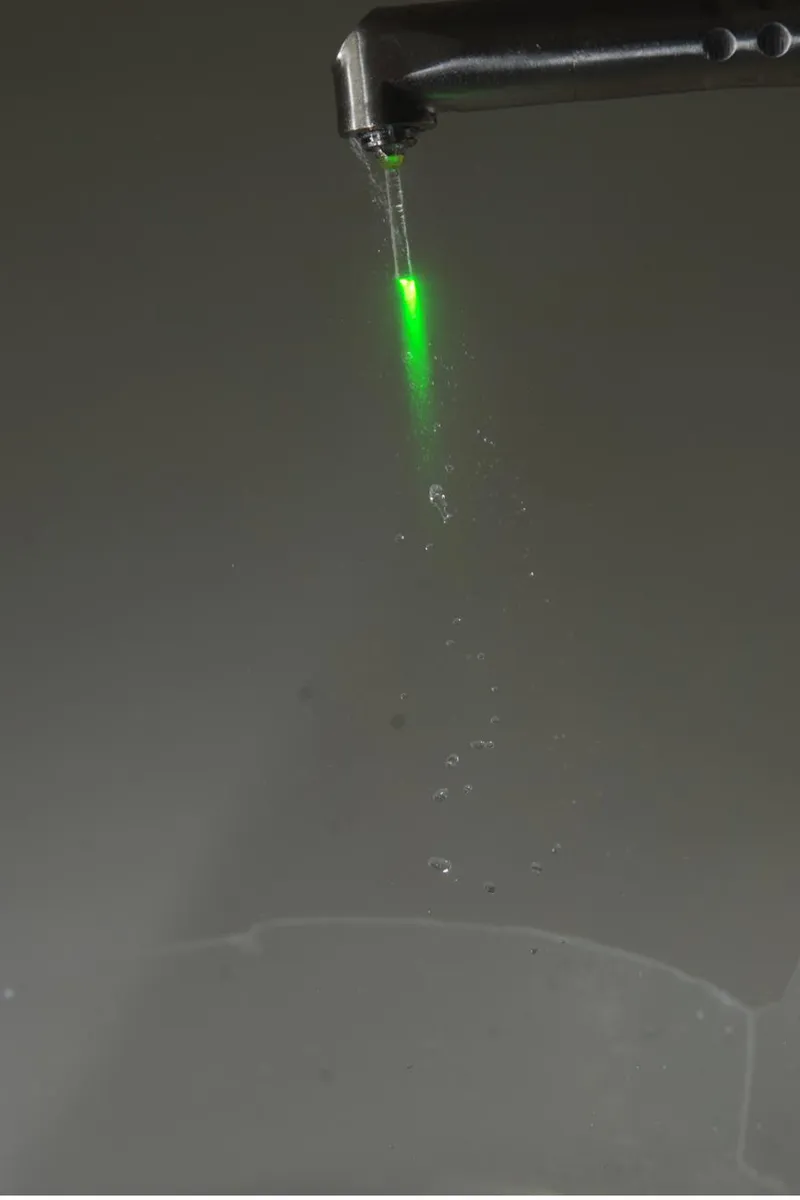
The Er:YAG laser pulses at 2940 nanometres — a wavelength that's strongly absorbed by water and hydroxyapatite. Healthy enamel contains little water. Decayed tooth tissue contains far more. The result is selective: the laser energy preferentially affects the soft, damaged tissue and leaves healthy structure largely untouched.
ii. The pulse
Vaporisation, not friction.
Each laser pulse lasts a fraction of a second and converts the moisture inside decayed tissue into vapour. The tissue is removed in micro-thin layers without the heat, pressure, or mechanical vibration of a high-speed bur. A fine cooling water spray keeps the surrounding tooth at a comfortable temperature throughout.
iii. The surface
A bonding surface ready for the filling.
As the laser removes decay, it simultaneously leaves a clean, micro-roughened surface — a kind of natural etching. This can support strong adhesion of the tooth-coloured composite filling that's placed in the same appointment, often reducing the need for additional acid etching steps.
iv. The limits
What the laser doesn't do.
The same physics that makes Er:YAG selective for decay also means it can't efficiently remove existing metal or composite fillings — those still require conventional instruments. Larger or deeply embedded cavities may also benefit from a combination approach. We'll be upfront about which method suits your tooth.
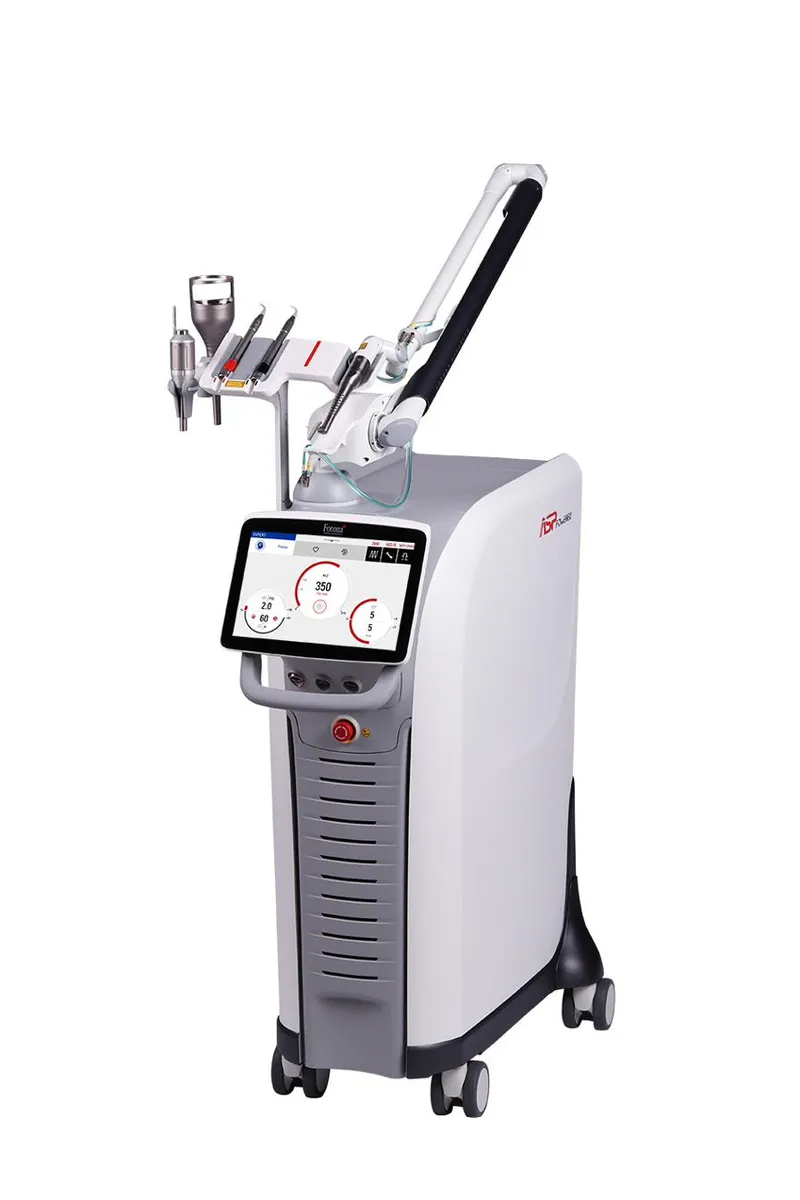 Fotona LightWalker II
The equipment
One platform. Two wavelengths. The same system used in laser dentistry research worldwide.
The Fotona LightWalker II is a dual-wavelength dental laser — Er:YAG for hard tissues like tooth structure, and Nd:YAG for soft tissues like gums. For cavity treatment, the Er:YAG arm does the work: precise, water-mediated removal of decay with constant cooling.
We chose the LightWalker because it's the platform most extensively documented in peer-reviewed dental literature for conservative cavity preparation, and because both Magical Smiles laser-trained dentists at Caroline Springs and Bacchus Marsh have been working with this system for years. Familiarity with the equipment matters more than novelty — every parameter is set deliberately for the specific tooth in front of us.
- Wavelength used
- Er:YAG · 2940 nm
- Cooling
- Integrated fine water spray
- Eye protection
- Provided for patient and team
- Regulatory status
- TGA-registered medical device
The appointment
What actually happens, step by step.
Uncertainty about the process is what keeps most people away. So here's the full sequence, from the moment you sit down to the moment you walk out. No surprises.
i.
Examination and X-ray
We confirm the size and location of the cavity, check for anything else that might affect treatment, and discuss what we're seeing on the imaging together.
5–10 minutes
ii.
The conversation
We talk through whether the laser is suitable for this particular tooth, what the alternatives are, and what to expect during and after. You stay in the driver's seat.
5 minutes
iii.
Comfort setup
You're settled into the chair, given protective eyewear (the laser is bright), and we run a brief test pulse on a non-sensitive part of the tooth so you know exactly what to expect.
3 minutes
iv.
Anaesthetic — only if needed
For small and early-stage cavities, often no injection is required. For deeper cavities, we may use The Wand — a computer-controlled system that delivers anaesthetic slowly and steadily.
0–5 minutes
v.
Decay removal
Short laser pulses with a fine cooling water spray. You'll hear soft tapping or popping — not the drill whine. Most patients describe the sensation as cool and gentle.
10–20 minutes
vi.
Surface preparation
The cavity is checked, gently dried, and prepared for bonding. Because the laser leaves a clean, micro-etched surface, this step is often quicker than with a drill.
5 minutes
vii.
Tooth-coloured filling
A composite filling is shaped and bonded in matching layers, then cured with a soft blue light. We sculpt it so it matches the natural anatomy of the tooth.
10–15 minutes
viii.
Bite check and polish
We check that the filling sits naturally with the opposite tooth, polish the surface so it feels smooth on the tongue, and talk you through what to expect over the next 24 hours.
5 minutes
Side by side
How the laser-assisted appointment actually differs.
Conventional treatment isn't the wrong choice — for many cavities it's still the right one. This is a plain-English comparison of what changes in the chair when the laser is suitable.
Conventional approachHigh-speed drill
Laser-assistedFotona Er:YAG
Sound
High-pitched continuous whine from the rotary handpiece.
Soft, intermittent tapping or popping — quieter overall.
Vibration
Significant — the spinning bur transmits through the tooth.
None — the laser has no moving mechanical part touching the tooth.
Heat
Friction heat is generated; managed with constant water cooling.
Brief pulse heat only; constant cooling spray throughout.
Local anaesthetic
Usually required for all but the most superficial cavities.
Often little or none for small, early cavities; case-dependent.
Precision
Mechanical cutting at the scale of the bur tip.
Micron-scale photoablation — selectively targets decayed tissue.
Best suited to
Larger cavities, replacing old fillings, complex restorations.
Early and small to medium cavities; anxious patients; children.
Recovery
Numbness from anaesthetic can last 2–4 hours after the appointment.
When no anaesthetic is used, you can eat, talk and work straight after.
Why Magical Smiles
Six things that shape the way we do this work.
Equipment alone doesn't make an appointment gentle. How the team uses it, plans for it, and talks you through it is what shifts the experience.
i.
Trained on the laser, not just licensed.
Our laser-trained dentists have worked on Fotona platforms for years across endodontic, periodontic and conservative protocols. The settings are tailored to your specific tooth, not pulled from a default.
ii.
An honest recommendation.
If the laser is the better choice for your cavity, we'll say so. If conventional treatment is more reliable for what you're facing, we'll say that too — and explain why in plain language.
iii.
A plan, before the chair.
You'll know what's happening, in what order, and roughly how long it takes before we begin. No surprise upsells once you've sat down. No mid-procedure "we also found another one."
iv.
Comfort tools beyond the laser.
The Wand for slow, computer-controlled anaesthetic delivery if it's needed. Noise-cancelling headphones. A weighted blanket on request. Children's appointments structured to feel low-pressure.
v.
Two clinics, one standard.
The same laser, the same protocols, and the same team philosophy at both Caroline Springs and Bacchus Marsh. You won't get a different experience depending on which appointment had availability.
vi.
Boutique, not boutique-priced.
The fillings are billed under the standard restorative item codes recognised by most private health funds. CDBS for eligible children. Payment plans available. We'll walk you through it before any treatment begins.
Common questions
The things people quietly wonder, asked out loud.
If anything in here doesn't quite answer your question, call the clinic — we'd rather explain it on the phone than have you guess.
Is laser cavity treatment painful?
Most patients describe the sensation as a series of soft taps with a fine cool water spray — quieter than a drill and without the vibration. Many small and early-stage cavities can be treated with little or no local anaesthetic, though deeper decay may still call for the standard numbing approach. Your dentist will assess what's likely to be most comfortable for your tooth at the consultation.
Do you still need a needle for laser fillings?
Often, no — especially for small, early cavities in healthy teeth, where the laser is gentle enough that local anaesthetic isn't required. For larger or deeper cavities, or for teeth that are already sensitive, anaesthetic may still be the kinder option. If it is needed, we use The Wand, a computer-controlled system that delivers anaesthetic slowly and steadily.
How does the laser actually remove decay?
The Er:YAG laser emits short pulses of energy at a wavelength (2940 nm) that is strongly absorbed by water inside tooth structure. Because decayed tooth contains more water than healthy enamel and dentin, the laser energy preferentially vaporises the softer, damaged tissue while sparing healthy structure. A constant fine water spray cools the tooth throughout.
Is the laser suitable for children?
It can be a good option for many children, particularly those who find the sound or sensation of the drill distressing. The laser is quieter, doesn't vibrate, and often doesn't require an injection — which makes the appointment easier for anxious kids. Suitability depends on the cavity and the child; our team will talk you through what's appropriate, including whether the Child Dental Benefits Schedule (CDBS) applies.
How long does a laser filling appointment take?
Most single-tooth laser cavity treatments take 30 to 60 minutes from start to finish, including the bite check at the end. Larger or more complex cavities may take longer. We'll let you know what to expect when we plan your appointment.
Can the laser replace my old metal or composite fillings?
Not directly. The Er:YAG laser is designed to work on natural tooth structure and decay. Existing metal or composite fillings need to be removed using conventional instruments. The laser can be used afterwards to clean and prepare the surrounding tooth for the new restoration.
Does the laser get hot? Is it safe for the tooth?
The Er:YAG laser pulses for fractions of a second at a time, and the handpiece delivers a fine cooling water spray throughout. This keeps the tooth at a safe temperature — quite different from the friction heat created by a high-speed drill. Both you and the dental team wear protective eyewear during treatment.
Does Medicare or private health cover laser cavity treatment?
Treatment is generally billed under the standard restorative item codes recognised by most private health funds with dental extras. Eligible children may access benefits under the Child Dental Benefits Schedule (CDBS), subject to Medicare terms. Our team will walk you through the costs and any rebates before treatment begins.
Which Magical Smiles clinics offer laser cavity treatment?
Laser cavity treatment with the Fotona LightWalker is available at our Caroline Springs and Bacchus Marsh clinics. Patients from the Point Cook area are welcome at either location — Caroline Springs is approximately 25 minutes away by car, and our team can help coordinate the appointment that suits your schedule.
Is laser cavity treatment new or experimental?
Er:YAG dental lasers have been used clinically for cavity preparation for more than two decades and are widely supported in the peer-reviewed dental literature. The Fotona LightWalker is a TGA-registered medical device used by laser-trained dentists around the world.
Where to come in
Pick the clinic that's closest to your kitchen, your work, or the school run.
Both Caroline Springs and Bacchus Marsh run the same Fotona laser, the same protocols, and the same laser-trained team — so the choice is really about your week, not your treatment. Point Cook patients are welcome at either; our team will help find the time that fits.
Bacchus Marsh
Point Cook
For laser-specific treatments, our team will help coordinate your appointment at Caroline Springs.
Across the laser suite
Other things the same equipment helps with.
The Fotona LightWalker is used across a range of treatments — each tuned to a different tissue and a different goal.
When you're ready
The cavity will keep getting smaller in your head and larger in your tooth.
Six more months of putting it off looks a lot like the last six. If you'd like to see whether laser treatment suits your particular filling, book a consultation — there's no commitment to proceed, and we'll be upfront if conventional treatment is the better fit.