Snoring
Particularly where mouth breathing is part of the picture and the airway narrows once everything relaxes.

Not every airway problem is a throat problem. For a lot of people, the noise at night, the jaw that aches by mid-afternoon and the mornings that never quite feel rested trace back to something much quieter — a mouth that sits open, a tongue resting in the wrong place, and muscles that learned the wrong pattern years ago. Myofunctional therapy with the Myosa® System works on that pattern rather than the noise it makes.
Myofunctional therapy isn't right for everyone, and it asks something of you. Worth knowing early whether you're in the group it tends to help.
This probably isn't the right page if your child is under ten and still growing quickly — the earlier, growth-guided version of this work is Myobrace® and myofunctional therapy for children.
It also isn't the right starting point if you've already been diagnosed with moderate or severe obstructive sleep apnoea and started CPAP. Your sleep physician leads that plan — though we're glad to talk about anything dental that supports it.
And if the snoring itself is the main thing you want addressed, our snoring and sleep apnoea page covers the other options, including NightLase.
This is the piece most people have never had explained to them. It's worth two minutes, because everything the treatment does follows from it.
Air taken in through the nose is warmed, humidified and filtered before it reaches the lungs. Breathing this way also keeps the lips gently sealed and holds the tongue up against the roof of the mouth — which is, quietly, where the upper jaw gets much of its shape.
Breathe through an open mouth for long enough and the tongue stops resting up top. It sits lower and further back, the muscles that hold it there weaken, and the lips lose the habit of sealing. None of this is dramatic day to day. It just becomes the new normal.
Lying down, with everything relaxed, a low-resting tongue has further to fall. It crowds the space at the back of the throat, air has to squeeze past, and tissue vibrates. That vibration is snoring. Mouth breathing during sleep is medically recognised as a form of sleep-related breathing disorder.
People usually arrive because of the end of this chain — the aching jaw, the snoring, the headaches. The treatment works further back along it.
Often it starts with something simple and long gone — blocked nose as a child, allergies, enlarged tonsils. The habit outlives the cause.
Without the seal, the tongue loses its resting place against the palate. The muscles holding it there get less work and gradually less strong.
We swallow hundreds of times a day. When the tongue can't push up, the lips and cheeks compensate instead — pressing inward, repeatedly, for years.
That altered pattern asks the jaw joint and its muscles to work in a way they weren't designed for. Over time that can show up as clicking, tension, headaches and wear.
This is why a nightguard can protect your teeth and still leave the grinding, the tiredness or the jaw tension where it was. A guard manages what the habit does. Myofunctional therapy is an attempt at the habit itself. Both have a place — they're just answering different questions.
Myosa® comes from Myofunctional Research Co, the Australian company behind Myobrace®. It has two halves, and the second one is the part that decides how well it goes.
A short film on the appliance, the airway, and the daily activities that go with it.
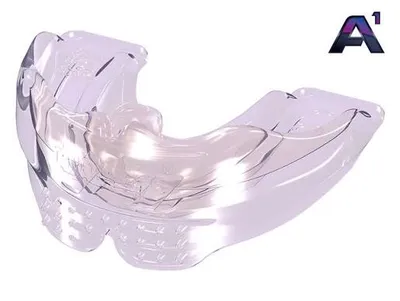
The Myosa® A1 — soft, clear and removable. No brackets, no wires, nothing fixed to your teeth.
Image is indicative only. The appliance used may vary depending on your individual needs and what the assessment finds.
Soft, removable, and worn for about an hour in the day plus overnight while you sleep.
There are no brackets, no wires, and nothing fixed to your teeth. The appliance is a soft intraoral device you put in and take out yourself. It holds the lower jaw gently forward, which opens the airway, and it encourages the tongue and lips back toward the position they should have kept.
Worn about an hour during the day and through the night. It opens the bite, brings the lower jaw forward to open the airway, and gives the tongue somewhere correct to sit while you're not thinking about it.
A short daily set of guided breathing and muscle exercises. This is the half that makes changes stick — retraining nasal breathing, lip seal, tongue posture and the swallow pattern so the appliance isn't doing all the work forever.
Rarely does anyone book in asking about tongue posture. They book about one of these — and the assessment works out whether the muscle and breathing pattern is part of the story.
Particularly where mouth breathing is part of the picture and the airway narrows once everything relaxes.
Waking often, waking dry, or never quite arriving at the deep part of the night.
The tiredness that survives a full eight hours in bed and doesn't have an obvious explanation.
Clicking, tightness, or ache in the jaw joint and the muscles around it — often worse late in the day.
Where a nightguard is protecting the teeth but hasn't touched what's driving the habit underneath.
The temple-and-jaw kind that build through the day, tied to muscles that never fully switch off.
The root habit itself — day, night, or both — and the work of shifting it back to the nose.
A tongue-thrust or compensating swallow pattern that keeps pushing against teeth and joint alike.
For teens past the age where the growth-guided approach applies, but where habits are still very much worth addressing.
Both come from the same Australian company and both work on breathing and muscle habits. The difference is what the body is still able to do at the time — and that's mostly about age.
For teens and adults, once active jaw growth has slowed or finished. The aim is symptom relief and habit change rather than reshaping how the jaw grows.
For children roughly six to ten, while the jaw is still growing quickly. Same habits addressed, but with the added chance to influence how the jaw develops and how much room the adult teeth get.
Nobody starts treatment on the first visit. The point of it is to work out whether the muscle and breathing pattern is genuinely part of your problem — and to say so plainly if it isn't.
Your sleep, your mornings, the jaw, the headaches, what your partner has noticed, what you've already tried. Bring anyone who shares a room with you if you can — they tend to know things you don't.
We check lip seal, resting tongue position, the swallow pattern, nasal airflow, jaw joint movement and how your bite comes together. It's observational and comfortable — no needles, nothing invasive.
Sometimes the answer is Myosa. Sometimes it's a sleep study with a referral to a sleep physician first. Sometimes it's an ENT opinion about why the nose is blocked, because no amount of retraining beats an airway that's physically obstructed. Sometimes it's "this isn't your problem" — and that's a useful answer too.
What we'd suggest, what it involves week to week, what it costs, and what we honestly think it will and won't change. Nothing is booked unless you want it booked.
You've been breathing this way for thirty years without anyone mentioning it. That's not a failing — it's just that almost nobody gets checked. The useful question isn't how it started. It's whether it's still worth changing now.
No — not for moderate or severe obstructive sleep apnoea. That is a medical condition that needs assessment and management by a sleep physician, and we'll help arrange the referral if there's any suggestion of it.
Myosa is used for mouth breathing, snoring and the muscle patterns behind them, and it may be considered in milder sleep-disordered breathing as part of a plan a physician is aware of. If you haven't been assessed and you're worried about apnoea, a sleep study is the right first step — before any appliance.
They come from the same Australian company and use the same underlying idea. Myobrace® is aimed at children while the jaw is still growing quickly, where there's a chance to influence how it develops. Myosa® is the teen and adult side, where growth has slowed and the goal is symptom relief and habit change instead.
If you're looking for the children's version, that's covered on our Myobrace and myofunctional therapy page.
It's individual, and it's measured in months rather than weeks. Some people notice symptom changes — jaw comfort, sleep quality — reasonably early. Retraining a breathing and swallow pattern that's decades old takes longer than that, and the daily activities are what determine the pace.
We'll give you a realistic timeframe for your situation at the assessment rather than a generic number here.
The appliance is soft and removable, and most people adjust to it over the first week or two. Early on it can feel bulky or make you produce more saliva, which settles. Some people find the overnight wear takes a few nights to get used to.
If something is genuinely uncomfortable rather than just unfamiliar, tell us — it usually means an adjustment is needed, not that you have to push through it.
Often yes, and they're addressing different things. A nightguard protects teeth from grinding damage. NightLase works on the throat tissues themselves. Myofunctional therapy works on the muscle and breathing pattern behind both.
What makes sense to combine depends on your particular picture — we'll talk it through rather than layering treatments for the sake of it.
Then that comes first. If there's a structural or persistent obstruction — chronic congestion, significant deviation, enlarged tonsils or adenoids — no amount of retraining will make nasal breathing comfortable, and it isn't fair to ask you to try.
In that case we'd suggest an ENT or GP opinion before starting, and pick this up afterwards if it's still relevant.
Muscles retrain at any age — that part isn't age-limited. What does change with age is what's realistic: in an adult we're not reshaping jaw growth, so the aim is symptom relief and habit change rather than the structural results possible in a growing child.
Whether that's worth doing depends on what's bothering you and how much it's affecting you. That's the conversation the assessment is for.
It depends on your fund, your level of cover and your remaining annual limits — appliance and consultation items are treated differently by different funds.
We'll give you the specific item numbers at the assessment so you can check your own entitlement before committing, and we'll go through fees clearly in person rather than by email.
Caroline Springs is our main location for myofunctional and Myosa® care. Airway and jaw assessments are available at all three clinics — choose whichever suits you and we'll take it from there.
Caroline Springs · Burnside · Taylors Hill
Bacchus Marsh · Maddingley · Darley
Point Cook · Williams Landing · Sanctuary Lakes
It's a conversation and a look, not a commitment. You'll leave knowing whether the way you breathe is part of what's bothering you — and if it isn't, we'll tell you that and point you at what is.
This page is general information about myofunctional therapy and the Myosa® System offered at Magical Smiles. It isn't medical advice and it isn't a diagnosis. Suspected obstructive sleep apnoea should always be assessed by a sleep physician, which we're happy to help arrange.
Outcomes vary from person to person and depend heavily on consistency with the daily activities. Suitability is assessed individually, and we'll discuss what is likely — and what isn't — before any treatment begins.
Myobrace® and Myosa® are registered trademarks of Myofunctional Research Co. Magical Smiles is not affiliated with the Myosa Centre.