Eating textures that feel hard
Gagging on lumpy food, refusing meat or bread, packing food in the cheeks, slow eaters who never seem hungry. Tongue mobility plays a quiet role in how children learn to chew and swallow.

A dentist, a speech pathologist or a GP may have used the words — or you've noticed something yourself at mealtimes. This page is for you: what a tie actually is, what an assessment involves, and what happens if release is recommended. Calmly, and without pressure to book anything until the assessment makes the answer clear.
Assessment first · not every tie needs release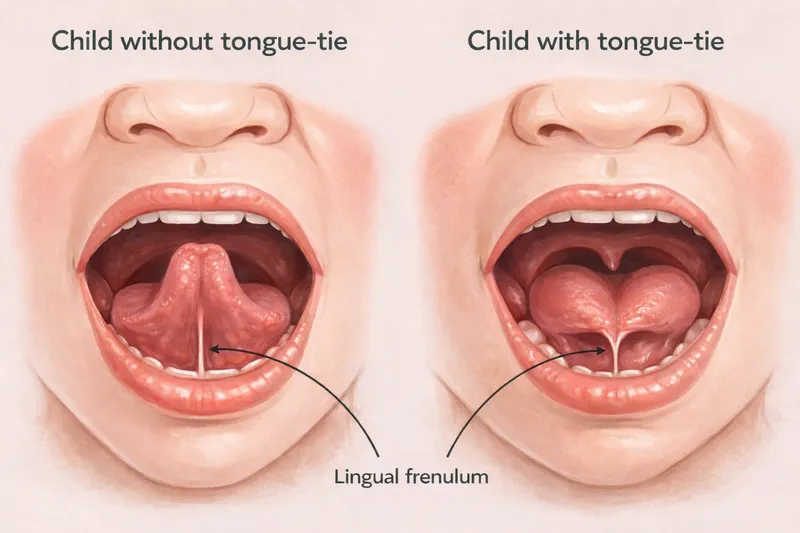
Diagram is illustrative and general — anatomy and severity vary between individuals.
The lingual frenulum is the thin band of tissue under the tongue. In most mouths it's loose enough that the tongue lifts and stretches freely. When it's shorter, thicker, or attached further forward, tongue movement is restricted — that's what's meant by a "tongue tie." A similar band under the upper lip can restrict lip movement instead, which is what's meant by a lip tie.
Both are assessed clinically and functionally before any release is considered. Anatomy alone is not enough — what matters is whether the restriction is causing a problem. An in-chair functional assessment is what actually determines whether release is appropriate for you or your child.
None of these on its own confirms a tie — not every speech or eating issue traces back to one. But these are the moments parents most often describe at a first consultation.
Gagging on lumpy food, refusing meat or bread, packing food in the cheeks, slow eaters who never seem hungry. Tongue mobility plays a quiet role in how children learn to chew and swallow.
Persistent difficulty with 'r', 'l', 's', 'th' — sounds the tongue tip needs height and flexibility to make. Speech pathology stays the lead; release is considered when restriction is clearly part of the picture.
A persistent gap between the upper front teeth (diastema), held in place by a thick labial frenum. Often a key consideration in orthodontic planning, and a quiet daily frustration in every photo.
An upper labial frenum that contributes to a diastema, recurring food trap, or recession at the front.
Magical Smiles performs laser tongue and lip tie release for school-age children, teens and adults — patients old enough to sit comfortably through a dental visit with local anaesthetic. We do not provide tongue tie release for infants or babies. For very young patients, we recommend assessment by a paediatric specialist or paediatrician — the protocol and clinical setting for that age group is best handled in specialist hands.
If that's your situation, you're still welcome to phone the clinic — we'll happily point you toward the right assessment pathway for your baby's age, and we're here when your child is older.
The release itself is brief. The reason we spend more time around it is so the assessment is right, the consent is informed, and the aftercare is something you can genuinely do at home in the weeks that follow.
A full history — what brought you in, speech and eating concerns if relevant, dental and gum observations. Calm room, no rush. Bring whoever you want.
Tongue elevation, lateralisation, speech sample, dental and periodontal check. Coordination with your speech pathologist, orthodontist or GP where applicable.
We talk you through what we found, whether release is genuinely indicated, what to expect, and the alternatives — including doing nothing. Written quote and timing.
The Wand (computer-controlled local anaesthetic) numbs the area gradually at a barely perceptible rate. Protective eyewear for everyone in the room.
You're comfortable in the chair, the area is fully numb. The laser portion typically takes 60–90 seconds. No scalpel, no scissors, no sutures in most cases.
We demonstrate the wound stretches you will do at home for 2–4 weeks — written instructions, a short video link, and a number to call if anything worries you. A follow-up visit at 1–2 weeks checks healing and movement.
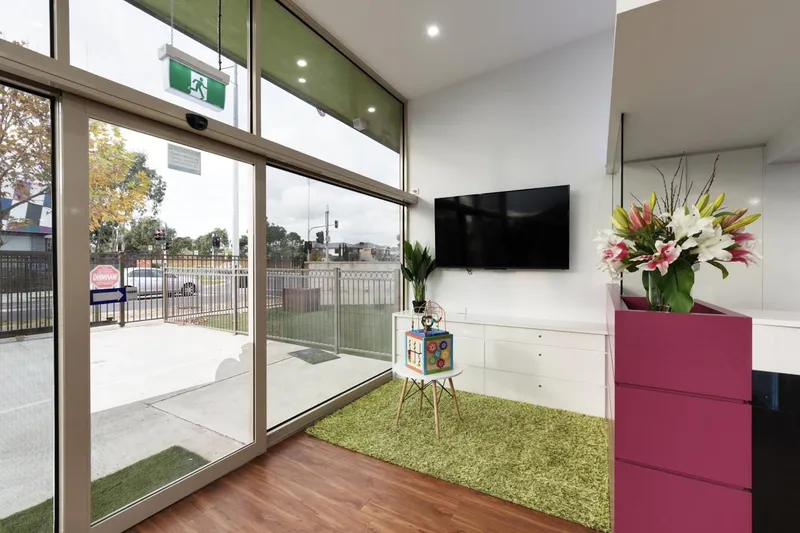
Dedicated paediatric-friendly rooms, dimmable lighting, a kids' lounge for siblings, and longer appointment times so nothing feels rushed.
For children and adults who need local anaesthesia, we use The Wand — computer-controlled flow that delivers numbing at a barely perceptible rate.
For our patients — older children, teens and adults — it means the appointment feels closer to a long filling than to surgery. You walk in, you sit comfortably, the area is numbed gradually, the laser does its work in seconds, and you walk out with aftercare instructions and a follow-up date.
This is the parent's version of the story. The complete clinical page — how the Er:YAG laser works, the Fotona LightWalker system, the scissor-versus-laser comparison, and the appointment broken into all eight steps — lives at Laser Tongue & Lip Tie Release. Nothing there contradicts anything here; it simply goes deeper.
And for everything else we do for kids — first visits, check-ups, bulk-billed eligible care and early orthodontics — start at the children's dentistry hub.
Ask anything else when you call — we would rather you ring with twenty questions than book unsure.
Book a consultation when it suits you. We will assess properly, explain plainly, and only recommend release if it is genuinely needed. The first visit answers the question — it does not commit you to anything.